BLOG POST
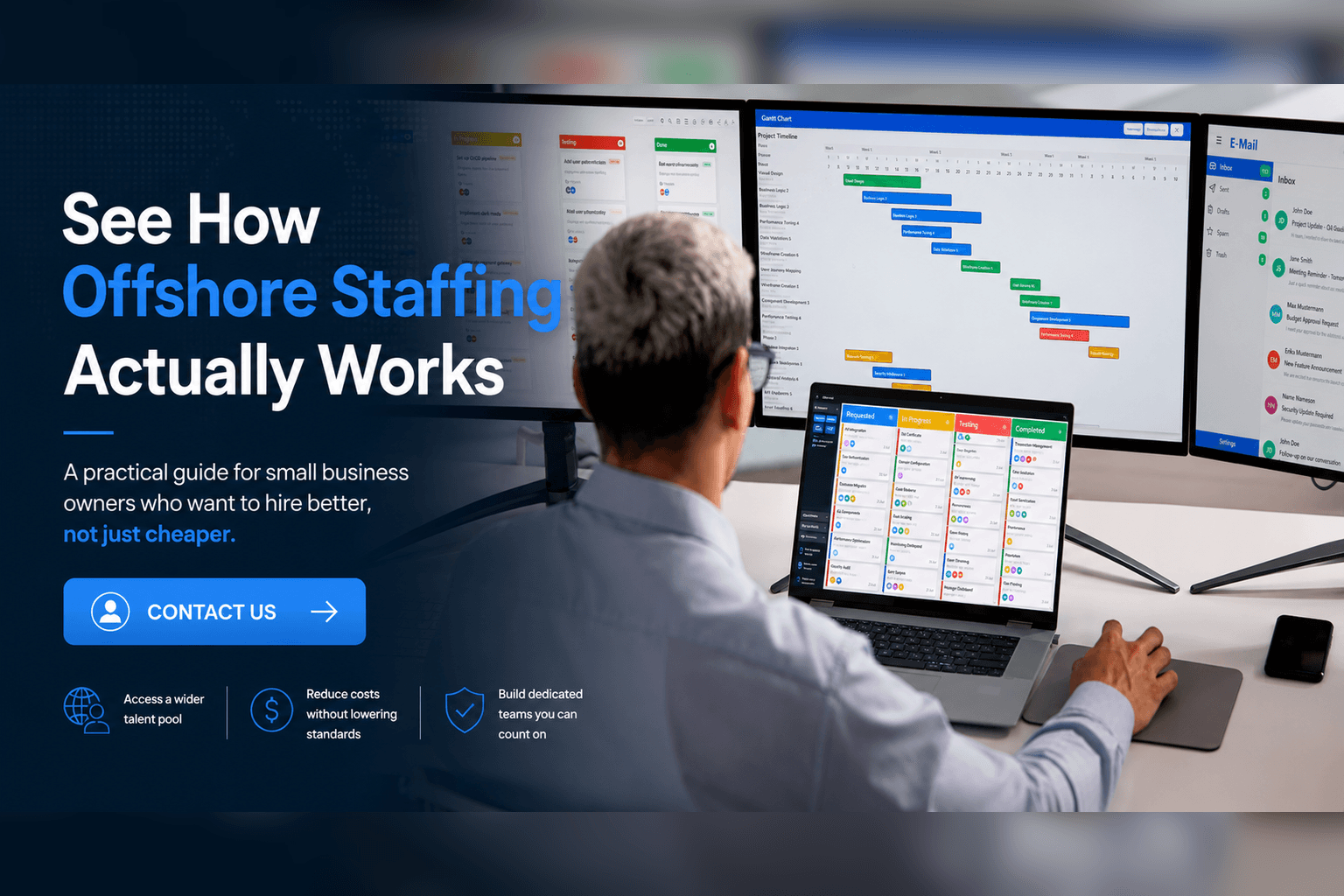
What Is Offshore Staffing? A Guide for Small Business Owners
•
Sagan Passport
•
18 min read
SECTION 1
8 Things Small Businesses Should Know About Offshore Staffing
SECTION 2
What Offshore Staffing Actually Is, and How It Works in Practice
If you run a small business, you've probably hit a wall with hiring at some point. The role you need filled doesn't quite justify a full-time local salary. Or you posted a job and got a stack of resumes that didn't fit. Or you found someone good, paid them well, and watched them leave six months later anyway.
Offshore staffing is one response to that situation. The basic idea is simple: instead of hiring someone who lives near you, you hire someone who lives in another country and works for your business remotely. They can be a full-time employee (not a freelancer, not a one-off contractor) but they happen to be based somewhere with a different cost of living.
That's it. The complications come from how you actually do it: where to find people, how to pay them legally, how to manage someone in a different time zone, and how to make sure you're not just paying for a warm body. Companies like Sagan Passport exist to help small businesses approach this in a structured way — handling recruiting, contracts, payroll, and the parts that tend to get messy when you try to figure them out on your own. But before you decide whether something like this fits, it helps to understand what offshore staffing is actually doing and where it tends to work or fail.
This isn't a pitch. It's a walkthrough.
SECTION 3
What Offshore Staffing Actually Is
A lot of terms get used interchangeably here, and they shouldn't be. Offshore staffing, freelancing, outsourcing, and agency work are different things, even though they sometimes overlap.
A freelancer is someone you hire for a specific project or a set of hours. They have other clients. You're not their employer. They use their own tools and methods. Upwork and Fiverr are the obvious examples.
Outsourcing usually means handing off a function entirely (say, your bookkeeping) to a company that handles it for many businesses. You don't manage the person doing the work. You manage the relationship with the company.
An agency is similar. You pay for a service. They assign people to your account. The people may rotate.
Offshore staffing is closer to traditional hiring. You bring on a person … dedicated to your business … who works inside your operations, attends your meetings, uses your tools, and reports to you. They live in another country. That's the only meaningful difference from a local hire, from your perspective as the manager.
Why this distinction matters: each model has different strengths and different failure points. Freelancers are flexible but inconsistent. Outsourcing is hands-off but often impersonal. Offshore staffing is more like building a team … which means you actually have to manage the person.
SECTION 4
Why Small Businesses are Looking Harder at Offshore Staff
The reasons most owners start exploring offshore staffing are pretty consistent.
Hiring locally is hard right now.
The labor market has shifted. Salaries for administrative, support, and operations roles have climbed. Good candidates are harder to attract for small businesses that can't compete with corporate benefits or remote-first tech salaries.
Costs are squeezing margins.
If you're a service business or a small operator, you've watched payroll, software, and overhead all go up. There's pressure to find ways to do more without spending more.
Flexibility is becoming more important.
Small businesses don't always have steady, predictable workloads. Sometimes you need someone for 20 hours a week, not 40. Or you need a particular skill you can't justify hiring full-time locally.
And there's the skills issue.
The kind of person who's great at managing your inbox, handling customer questions, and keeping your calendar straight isn't always easy to find at a price you can pay. The same is true for marketing coordinators, bookkeepers, or operations support.
None of these is a unique problem. They're the regular tensions of running a small business. Offshore staffing is one possible answer … not the only one, and not always the right one.
SECTION 5
Where Offshore Staffing Tends to Work
The roles that translate well usually have a few things in common: the work is repeatable, the outputs are clear, and most of the communication can happen asynchronously or on scheduled calls.
Administrative and virtual assistant work is the most common starting point.
Calendar management, email triage, travel booking, document prep, data entry, and light project coordination. The kind of work that takes time but doesn't require deep institutional knowledge to start.
Customer support is another.
Email tickets, live chat, basic troubleshooting, and order issues. As long as you have documentation and a clear escalation path, this works well across borders.
Marketing support fits when the work is structured.
Social media scheduling, content formatting, blog post drafting, email campaign setup, light graphic design. Strategy is harder to offshore. Execution is not.
Operations and bookkeeping roles also work.
Invoice processing, AR/AP, reconciliations, basic reporting, vendor coordination. Anything with a repeatable workflow and clear rules.
Where it gets harder: roles that require constant in-person presence, deep cultural context, sensitive client-facing work, or judgment calls that depend on years of being inside your specific business. That doesn't mean it can't work eventually. It just means it's not the right place to start.
SECTION 6
What Offshoring Costs
Cost ranges vary widely by country, role, and experience level. Generally, you're looking at salaries that are meaningfully lower than US or Western European equivalents, but not the rock-bottom rates people sometimes imagine.
For an experienced virtual assistant or operations associate, monthly costs tend to land somewhere in the range of what a part-time local hire might cost, but for full-time work. For more skilled roles like marketing specialists or junior accountants, you'll pay more, but still less than a comparable local hire.
The number that matters more than the headline rate is whether the cost is predictable. Hourly freelancers can be cheap on paper and expensive in practice … bills creep up, scope shifts, communication gaps eat hours. A monthly salary structure, where you know exactly what you're paying and exactly what you're getting, tends to be easier to plan around.
There are also platform fees, payroll fees, and compliance costs depending on how the arrangement is structured. This is one of the areas where transparency matters. A reasonable provider will lay out exactly what you pay, what the worker receives, and what goes to administration. If you can't get a clear answer to that question, that's a sign to keep looking.
SECTION 7
What You Actually Get from Offshoring
The real benefits aren't dramatic. They're practical.
You get access to people you wouldn't otherwise be able to hire.
There are excellent candidates in the Philippines, Latin America, South Africa, and elsewhere who would be strong hires anywhere; they just happen to live in places with different cost structures. For a small business, this opens up a wider pool than your local market gives you.
You get flexibility.
You can start with one part-time role, grow into a full-time role, and add a second person when you're ready. You're not locked into a long contract or a service package. The relationship can scale with your business.
You get cost efficiency.
This is the part that's most often overstated. Yes, salaries are lower. The actual return depends entirely on whether the role is producing value. A cheap hire who isn't managed well costs more than an expensive hire who is … because you are paying for poor output.
This is the part most people miss. Offshore staffing isn't really a cost play. It's a hiring play with a cost-benefit attached. If you treat it as cheap labor, you'll get cheap results. If you treat it as building a team, you'll get a team.
SECTION 8
Where It Can Go Wrong with Overseas Staff
Most failures aren't about the model. They're about management.
Poor communication is the most common one.
Owners assume the new hire will figure things out, ask questions when stuck, or pick up context from being around. Then they're surprised when work stalls. The fix isn't hiring better people. It's communicating more deliberately: written instructions, recorded explanations, and regular check-ins.
Weak onboarding is the next one.
Throwing someone into a role with no documentation, no training, and no clear sense of priorities is a recipe for failure with any hire. It just shows up faster when the person is in another time zone and can't tap you on the shoulder.
Unclear roles cause more problems than anything else.
If you can't write down what success looks like in this role, you're not ready to fill it … locally or offshore. The ambiguity gets exposed quickly when you're not in the same room.
Bad expectations are the quiet ones.
Some owners assume offshore hires will work the way local employees do, but at lower cost. Others assume they'll be self-directed contractors who don't need management. The reality is in between. They're employees who need clarity, structure, and consistent management … like everyone else.
Here's the part worth sitting with: every problem in this list is a management problem. Local hires fail for the same reasons. The difference is that with a local employee, you can sometimes paper over weak management with proximity; running into them in the kitchen, fixing things in the moment. With offshore staff, weak management has nowhere to hide.
That's actually the value of looking at this question seriously. It forces you to manage well. Businesses that figure out how to onboard, document, and manage offshore staff almost always end up with better systems for everyone, including their local team.
SECTION 9
How to Actually Use Remote Staff Well
A few things make the difference.
Be clear about the role before you hire.
Write down what the person will do, what success looks like at 30, 60, and 90 days, and what tools they'll need. If you can't, slow down. Hiring into a vague role wastes everyone's time.
Take onboarding seriously.
Plan a real first two weeks. Build out documentation, even if it's rough. Record screen videos walking through processes. Set up regular check-ins for the first few months. The up-front investment saves months of confusion.
Manage consistently.
A weekly one-on-one. Clear priorities each week. Feedback when work is good and when it's not. Most offshore hires who fail aren't bad workers … they just never got the management they needed.
Treat them as part of the team.
Include them in standups. Use their name. Talk about their work in front of others the way you would any employee. The dynamic in which offshore staff is treated as invisible labor is the one in which things fall apart.
Pay attention to time zones.
You don't need full overlap, but a few hours of overlap each day makes communication much easier. Build the schedule around what the work actually requires.
None of this is unusual. It's regular management, applied with a bit more discipline because the distance demands it.
SECTION 10
When it Fits, and When it Doesn't
This works for businesses that are growing, have repeatable work piling up, and have an owner or manager who's stretched too thin to do it all. If that describes you, the math usually works once you find the right person and put the right structure around them.
It tends to fit roles where you can clearly describe the work, set measurable goals, and check in regularly. Admin, support, ops, marketing execution, bookkeeping … these are well-traveled paths.
It doesn't fit when the role is unclear, when you don't have time to manage anyone, or when you're hoping to solve a problem by hiring a person without thinking through what they'll actually do. Those are the cases where it fails, and they would also be cases where local hiring fails, just more slowly.
It also doesn't fit if the expectation is bargain-bin labor. People who do this work well are professionals with options. Treating the relationship as transactional or extractive will burn out good hires fast and leave you cycling through replacements.
If you're not sure whether your business is ready, that's a useful signal. The honest answer is usually: not yet, but soon, after you tighten up your processes.
SECTION 11
To Summarize…
Offshore staffing isn't a magic answer or a shortcut. It's a way to build part of your team by tapping a wider talent pool than your local market offers. Done well, it can give a small business real leverage. Done poorly, it's a frustrating, money-losing experiment that gets blamed on the model when the real problem is management.
The framing that helps most: don't think of this as buying cheap labor. Think of it as hiring someone who happens to live somewhere else. The questions you'd ask about any hire … what does this role do, how will I manage it, what does success look like … are the same questions, just with more emphasis on clarity because you can't rely on hallway conversations.
Whether you eventually use a structured provider like Sagan Passport or piece something together yourself, the underlying work is the same. Define the role. Set expectations. Onboard properly. Manage consistently. Treat the person as a real employee.
If you can do those things, offshore staffing can be one of the most useful moves a growing small business makes. If you can't, no hiring decision (local or offshore, expensive or cheap) is going to land the way you want.
The question isn't really whether offshore staffing works. It's whether you're ready to manage someone well. Once that's true, the geography stops mattering.
More from the blog
BLOG POST
What It Actually Costs to Hire an International Remote Employee (and When It Makes Sense)
10 min read
Ready to build
your offshore team?
Hire better.
Not just cheaper.
Get matched with top overseas talent and a dedicated support team.
Schedule a Call →
◇ Pre-vetted, top 1% talent
◇ Full-time, dedicated team members
◇ Payroll, compliance & HR support
◇ Start in as little as 2–3 weeks